Every January, millions of people start a restrictive diet. By June, most are back where they started. By the next January, the cycle starts again.
This isn't a willpower problem. It's a food restriction problem. And the more we learn about how the body and mind respond to restriction, the clearer it becomes: the very thing most people use to fix their relationship with food is the very thing that breaks it.
There's a different approach. It's not new — it's how humans ate for most of history before diet culture turned eating into a moral test. Kroma calls it nourishment over restriction, and the science behind it is more solid than the marketing behind any diet plan.
Why Food Restriction Backfires

Restriction-based eating fails for three reasons — biological, psychological, and behavioral. They compound on each other.
1. Your Metabolism Adapts to Defend Your Weight
When you eat significantly less, your body slows its energy expenditure to compensate. This is called metabolic adaptation, and research shows it can persist for at least a year after weight loss — sometimes longer. The NIH "Biggest Loser" study famously found that participants' metabolisms remained suppressed six years after the show ended, even after they regained weight. Restriction doesn't just slow your metabolism — it rewires it.
2. Your Hormones Fight Back
Caloric restriction increases ghrelin (the hunger hormone) and decreases satiety signals like GLP-1, PYY, and leptin. The hungrier you get, the harder it is to make calm food choices. Studies on calorie restriction show these hormonal shifts persist long after the diet ends — which is why "discipline" runs out and the rebound happens.
3. Restriction Drives Binge Cycles
The research on disordered eating is clear: dietary restriction is one of the strongest predictors of binge eating. When the brain learns food is scarce, it primes a loss-of-control response when food becomes available. The harder the restriction, the steeper the rebound. This isn't a character flaw — it's neurobiology doing exactly what it evolved to do.
What Nourishment Over Restriction Actually Looks Like
A healthy relationship with food isn't built on rules — it's built on patterns that work with your biology instead of against it. Here's what nourishment-led eating looks like in practice.
Add Before You Subtract
Restriction asks what you can cut. Nourishment asks what's missing. Most people who feel "out of control" with food are under-fed in specific ways — not enough protein, not enough fiber, not enough sleep. Adding nutrient density — protein, vegetables, healthy fats, nourishing foods — quiets cravings faster than cutting anything ever could.
Eat Enough at Each Meal
Under-eating earlier in the day almost guarantees overeating at night. A protein-anchored breakfast and a substantial lunch are two of the highest-leverage habits in nourishment-led eating — they stabilize blood sugar, regulate hormones, and remove the biological pressure that drives end-of-day cravings.
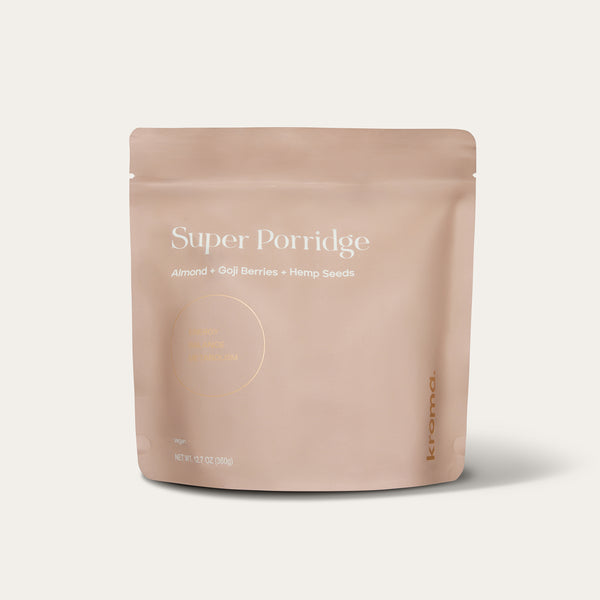
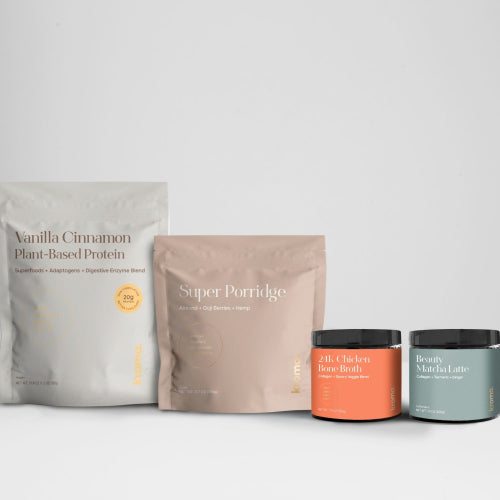
Kroma tip: Super Porridge and 24K Bone Broth are low-effort ways to anchor real protein into mornings and afternoons — exactly when most people under-eat.

Practice Mindful, Intuitive Eating
A 2021 meta-analysis of intuitive eating found it consistently associated with lower binge eating, less psychological distress, better body image, and higher self-esteem — without weight regain typical of restrictive diets. Mindful eating — slowing down, noticing hunger and fullness, eating without distraction — is what makes intuitive eating actually work in real life.
Treat Food as Medicine — Not Morality
There's a real difference between food as medicine (using food to support your body) and food as morality (using food to prove something about yourself). The first leads to consistency; the second leads to shame, cycles, and burnout. Healthy eating without dieting starts with dropping the second framing entirely.
The Foundation: What Nourishment Actually Means
Before any of this works in practice, the underlying definition has to land. Nourishment is broader than nutrition — it spans body, mind, and soul, and it shows up in everything from food to sleep to relationships. For the full picture, see our companion piece on what nourishment actually is. That foundational definition is the ground this entire approach stands on.
FAQ: Nourishment vs Restriction
Why do diets fail so often?
Restriction triggers a coordinated biological defense — slower metabolism, higher hunger hormones, lower satiety signals — that persists for months or years after the diet ends. Combined with the psychological binge-restrict cycle, this is why most diets fail long-term, regardless of the specific plan.
What is intuitive eating?
Intuitive eating is an approach where you respond to your body's hunger and fullness cues rather than external food rules. Research consistently links it to lower binge eating, better body image, and a more stable weight long-term — without the rebound that restriction produces.
Is it possible to eat healthy without dieting?
Yes — and the research suggests it's the only sustainable way. Healthy eating without dieting focuses on adding nutrient-dense foods, eating enough at each meal, slowing down, and dropping food morality. Habits beat rules.
The Bottom Line
Restriction is the loudest approach to food. It's also the one with the worst long-term track record biologically, psychologically, and behaviorally.
Nourishment is quieter. Less dramatic. But it's the only approach that actually compounds. Add real food. Eat enough. Slow down. Drop the morality. The rest of a healthy relationship with food tends to follow.
Build nourishment into your routine with Kroma. Explore the Kroma 5-Day Reset — built around nourishment, not restriction and our Daily Rituals for everyday support.
References
Last Edited: August 12, 2026